Donna Potts, Sunderland
I was diagnosed with stage 3 bowel cancer in January 2024, aged 42.
About two years before my diagnosis, I gradually started to lose weight without trying and my appetite wasn’t as big. I was a bit overweight, so I was quite pleased that I was losing weight and didn’t really see it as a problem. In hindsight, alarm bells should have been ringing. However, I was happy I had dropped a couple of dress sizes and everyone kept telling me how great I looked. It all felt like a positive.
I also started to notice that I was very tired, but I put this down to having a busy, stressful, full‑time job as a community nurse, alongside an active life outside of work. I noticed gradual changes in my bowel habits too. I’d often go out for dinner, but later that evening I would be woken up with stomach cramps and loose stools. Again, I dismissed this, thinking I might have developed food intolerances or that the food was simply too rich for me. Alarm bells still weren’t ringing, despite my family history of bowel cancer, which I was only partially aware of at the time. I knew my aunt had bowel cancer, but I didn’t know that my grandfather and two uncles had died from it.
About ten months before my diagnosis, I developed a sharp, shooting pain under my left rib. I remember going to the GP and explaining that it felt like a painful organ inside my body. I was told it was probably muscular pain and I thought I was just being dramatic. Over the next few months, the pain came and went; I would take painkillers and it would pass.
I also started noticing that there was occasionally red blood in my stool, but I didn’t think it was happening often enough to see the GP.
At the beginning of January 2024, I started vomiting. I thought I had norovirus, combined with stomach pain and cramps. My symptoms continued to worsen and after a few days I went to the GP. Blood tests were taken and came back abnormal and I then passed a very small stool with red blood. I was quite dehydrated and on 9 January my GP advised me to go to A&E.
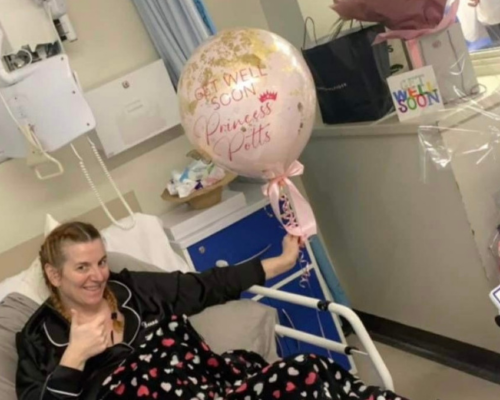
I had an ultrasound scan, which showed something abnormal around my left rib area. I was admitted and sent for a CT scan, which revealed a blockage in my bowel, causing a build-up that was on the verge of rupture. I was told they weren’t sure what was causing the blockage, but that it could be a tumour. I was taken for emergency surgery and a tumour was found and removed immediately. A few days later, I was told I had stage 3 bowel cancer. I spent my birthday recovering in hospital — the absolute worst way to spend a birthday.
I was frightened, thinking my life might never be the same again, or that I might even die. I had a couple of panic attacks in hospital, but the nurses and doctors were incredibly supportive. I never thought I would get cancer at my age, as I had always considered myself to be a healthy person. The diagnosis felt life‑changing, and I wasn’t sure how, or even if, I would recover from it.
I was discharged about three weeks after surgery and referred to oncology. I then started adjuvant chemotherapy with capecitabine — eight cycles from April to September 2024.
Chemotherapy was exhausting. I felt tired and weak most of the time and had very little appetite. I was also dealing with ongoing bowel urgency following surgery, which meant many frequent trips to the toilet. I spent a lot of time going back and forth between my bed and the bathroom. Mentally, it was very hard.
When chemotherapy ended in September 2024, I felt incredibly lucky and emotional ringing the bell. I felt hopeful for the future and optimistic that I could soon get my life back to “normal”.
Gradually, week by week, I started to feel better. In November, my husband and I went to Tenerife. Relaxing in the warm weather helped me feel like life really could return to normal again.
I went back to work in January 2025 after a year on sick leave. At a follow‑up scan, I was told I needed an MRI because something had been spotted in my liver duct. I immediately feared the worst, but I was diagnosed with portal vein thrombosis — a blood clot in my liver duct. I was told this was most likely a complication from surgery or chemotherapy and it was treated with six months of blood thinners. I was so relieved it wasn’t cancer again.
In August 2025, I experienced internal bleeding caused by the blood clot and lost a significant amount of blood, passing black stools rather than red. I developed anaemia and needed a couple of short hospital admissions for treatment. Once again, I had to take sick leave from work.
I returned to work in December 2025, and I’m now feeling much better. My bowels have slowly improved, I feel far more positive about the future, and most importantly, I'm still cancer‑free two years on.
It has been an absolute rollercoaster — full of ups and downs — and at times it felt completely derailed and out of control. I’ve learned to ride it as best I can. I’ve made lifestyle changes, including cutting out alcohol and eating less processed food and I feel much better for it. I feel incredibly lucky to be alive and this experience has made me truly appreciate my life and the people around me.
I want to offer hope to others: don’t ignore symptoms and always put your health first.