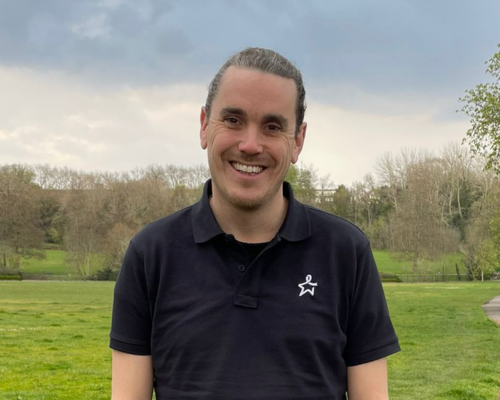
Dan Ridge, South East London
Dan was diagnosed with bowel cancer aged 38 in 2023.
It took falling off my son’s hoverboard and injuring my back, for me to see the doctor. They gave me a physiotherapy form to fill out about my back injury, but the answers I gave to the bowel habit questions raised a red flag about some symptoms I’d been too ’blokey’ to do anything about. At this point, I was going to the toilet more than ten times a day and I’d also noticed blood in my stool and felt very tired. Originally, I consulted Dr Google, and the answer seemed to be stress, which made sense.
My physiotherapist advised I see my GP. On my first appointment, the GP gave me a FIT test to complete at home and it came back positive. I was referred for a colonoscopy, but it couldn’t be completed as the tumour was blocking my bowel. I had a CT scan and an MRI scan and was diagnosed with stage 3 bowel cancer.
The plan was to have chemotherapy and possibly also chemo-radiotherapy to reduce the size of the growth before then having surgery to remove it. Following the main surgery, I would be required to have an ileostomy operation to fit a stoma bag whilst the affected area healed.
Dealing with a blocked bowel
The need for a stoma bag was a big shock for me, and the length of time I would need it. That worried me the most, it felt like a huge lifestyle change.
It was recommended that I have it fitted the very next day because the blockage in my bowel was that bad. I was unsure as I really didn’t want the stoma, but I learnt that chemo could actually inflame the tissues in my bowel and make my blockage worse. The risk of the blockage causing severe problems during treatment wasn’t a risk worth taking, so obviously I agreed. The issue of my blockage becoming more of a problem came about quicker than expected, I was admitted through A&E hours only later in the middle of the night with severe pain.
My wife had to drive me to A&E as I wasn’t able to pass anything through my bowel causing me severe pain and vomiting. I think I had a panic attack at this point, I didn’t want my bowel to explode and I was fearing the worst. My breathing was off, I had a fever, still being sick and my whole body seemed to gain a rash all over as I went bright red. My legs were cut because I was itching so much. I was in a state. Eventually I had a bed and enough drugs to calm me down. The vomiting eventually stopped, but now I was relaxed enough I was finally able to pass whatever had been blocked in my bowel... and then some.
I had several hours of diarrhoea and as I was too weak to get up so I just had to go where I was lying. I felt so sorry for the nurses who had to keep changing me, but they didn’t moan and were very kind. I also got very dehydrated, the catheter was inserted (felt that a lot, even with all the drugs) and my urine was very dark brown. My kidneys were stripping any moisture they could get their hands on. Even my surgeon was ‘impressed’ by the colour. Needless to say, I didn’t get my surgery that day, as I needed to recover. But at least I was in the right place.
Getting a stoma fitted
After a delayed start it was my turn for surgery. Saturday 1 April (insert your own April fool’s joke here), I’ve not had anything to eat or drink since Thursday evening, I’m raring to go. The anaesthetists put me under and I woke up what appeared seconds later trying to fight them off me. Slight issue where there was a bit of bleeding so they had to give me a double barrel ileostomy, but apparently this is quite common.
I’m back in my private room with my wife and mum who had been anxiously waiting, with the new addition of a stoma bag attached to my stomach. It’s a bit weird but by this stage I’ve taken on quite a practical and positive approach to it all so I’m doing ok. I just want to get on with things and hope to get used to having the bag that it just feels like the norm.
I get moved in the middle of the night to the ward, but I don’t mind as I get to meet some lovely people all going through slightly different scenarios. I am the youngest by a few decades with the eldest being 87. Their positivity really helps me through the next few days in hospital.
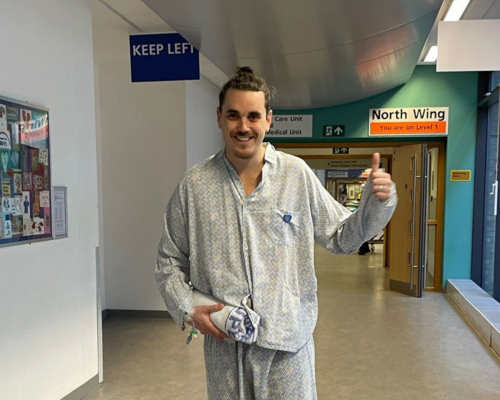
I had one bad night where I was sick and started panicking again, but otherwise I was ok, I just had to take it easy and recover. The staff were all great and took care of me. I was eventually allowed to eat a few days later and by that point hospital food tasted great. I left hospital on Wednesday 5 April.
Signing up for ActiveApril and coping with chemotherapy
When I found out it was Bowel Cancer Awareness Month only days after my diagnosis, well I had to do something didn’t I! I signed up to ActiveApril and started doing a bit of activity every day, starting with a few walks around the wards in hospital.
My chemotherapy (CAPOX (XELOX) (capecitabine and oxaliplatin)) began toward the end of April. Because I was only 38, the doctors were able to give me stronger doses of the treatment and many of them jokingly referred to me as their “baby.” The upside was that the specific treatment plan meant I could keep my hair, which felt like a small but meaningful piece of good news.
One of the strangest side effects was an extreme sensitivity to cold. Anything even slightly cool felt like ice. I had to wear gloves and a scarf constantly, and something as simple as touching the metal hospital doors after my IV would hurt. Beyond that, the main challenge was severe tiredness. I could manage it, but it meant carefully planning activities around rest weeks every three weeks.
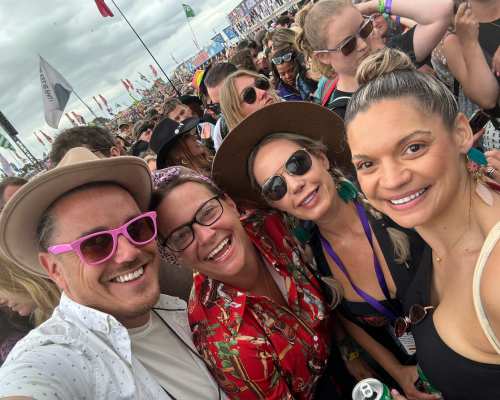
Despite everything, I was determined not to let cancer take over my life. I still went to my brother’s wedding, still went to Glastonbury and even played in my annual softball league — actually having my best season yet. Staying social was hugely important to me. Filling my calendar, keeping friends and family around me and staying positive became my way of coping. What I didn’t realise at the time was that the positivity and constant activity were also a way of avoiding my deeper feelings.
Surgery to remove the cancer
My surgery took place on August 13. Chemotherapy had shrunk the tumour by about 50%, which meant I could skip radiotherapy and go straight to surgery. There was a small complication, so they had to make a larger incision, leaving a long scar, but the operation was successful. They removed the cancer completely.
Handling the emotional impact of a stoma
Even after hearing that, it didn’t fully sink in. I still had the stoma bag at that point, and because I had mentally associated the bag with the cancer itself, its presence made me feel like I still had cancer. Changing it every day became traumatic — it felt like reliving the whole experience repeatedly. I didn’t know whether the bag would be permanent and the thought of living with it forever was unbearable. I became deeply depressed and even suicidal. It was an odd contradiction: my life had just been saved and yet I couldn’t imagine living with the bag long-term.
I reached out for help. I joined Bowel Cancer UK’s support group, which was incredibly comforting. Sharing my experiences with people who truly understood helped ease some of the emotional weight. I also began therapy, which ended up being life-saving. Facing the trauma directly was difficult, but it allowed me to understand that my struggles were normal given what I’d been through. “No wonder I’m struggling” became a quiet mantra that helped me show myself some compassion. I also developed small coping strategies — like playing the Rocky theme while changing the bag — to get through each day.
Eventually, after healing and one final round of chemotherapy, it was time for the tests that would determine whether I could have the reversal surgery. The first scan showed everything had healed well, but the colonoscopy suggested the area was too narrow. My scheduled surgery was cancelled and I was devastated. Thankfully, my surgeon wanted to repeat the colonoscopy himself. After examining it, he confirmed that the reversal was possible. That was the best moment of the entire journey up to that point.
The reversal surgery took place on 16 July 2024. I was nervous going in because I didn’t know whether I would wake up with or without the bag. When I woke and saw it was gone, I felt overwhelming relief — the happiest moment of the whole ordeal.
Recovering after the stoma
Recovery wasn’t straightforward. I was told I could leave the hospital once I’d had my first bowel movement and my friends and I even made a sweepstake out of it. But the pain medication caused intense constipation and excruciating pain. Eventually, after coming off the medication, I managed to go, and despite the crying and the agony, it felt like a victory. I went home, only to end up back in hospital the next day because of severe pain and panic. Thankfully, after a scan, I was cleared to return home again, and things slowly improved from there.
Moving forwards
Recently, I celebrated my 40th birthday — something I’d set as a milestone to reach cancer-free. I gathered friends and family to thank them and to celebrate both my birthday and beating cancer. I was finally able to tell my children what I had actually gone through; they had known about the bag but not the full story. They’re incredibly proud and tell people freely that their dad beat cancer.
Even now, I’m still processing what I’ve been through. Anniversaries, TV scenes, or even small reminders can bring up overwhelming emotion. It still doesn’t quite feel real that I’ve survived it all. But each day gets a bit easier and I'm relieved to finally be getting back to life without cancer hanging over me.