Charlie O’Brien, London
I was diagnosed with stage 3 bowel cancer aged 43 after presenting at A&E. My cancer diagnosis was confirmed on 29 January 2025, although doctors told me they were pretty sure it was cancer a week before.
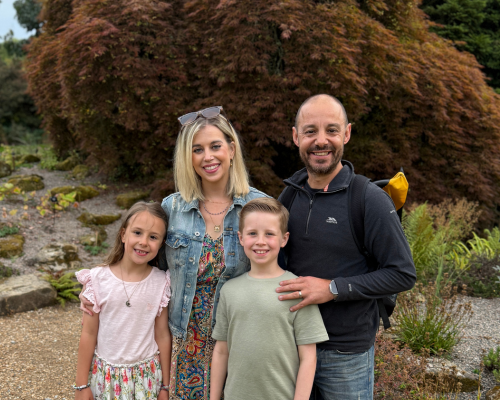
I’m Charlie, a 44-year-old mum of two to my son, Noah, and my daughter, Luna. Before they were born, I had a busy career in journalism and broadcasting and was a Heart radio presenter. I’m married to Jason King (JK) who also broadcasts on Heart across the country. After becoming a mum, I began training to be a counsellor and therapist and was running a busy private therapy practice when I was diagnosed.
Having read many diagnosis stories, mine seems to be a more unusual way to be diagnosed. I am keen to share my story so that others can recognise symptoms earlier than I did and be more proactive than I was.
Thinking back
I’m one of those people who has had IBS as long as I can remember. At school I would frequently struggle with pain and bouts of constipation or diarrhoea, but nothing was ever diagnosed. Into adulthood things settled down a lot, but I would describe my bowels as ‘niggly’. While I suffered on-and-off discomfort, it wasn’t out of the ordinary for me. I now think this is part of the reason I was diagnosed with bowel cancer so late.
In hindsight, I can now piece together symptoms from the couple of years before my diagnosis, but they weren’t so obvious at the time. As well as some nighttime hot flushes and heart palpitations – which have all stopped since my tumour was removed – I’d been experiencing a ‘pulling’ sensation in my left-hand side for some time, almost like a stitch or bad trapped wind. It usually passed quickly, but it was enough for me to go to the GP seven months before I was diagnosed. I had an ultrasound to rule out problems with other organs.
Here’s the bit that I’ll feel cross and guilty with myself about for the rest of my life — my GP gave me a FIT test and I never did it. She gave me the test while London hospitals were in the midst of a serious cyber-attack. A lot of routine testing was unavailable, including FIT tests. She told me to hang on to the kit and do it once the cyber-attack was over and testing could be done once more. The security issue lasted for a few weeks, by which time my symptoms had subsided, the test kit had got buried in the back of my bathroom cabinet and I’d forgotten about it. I often wonder how much less traumatic things could have been for me if I’d just done that test.
Diagnosis and surgery
By late November/early December 2024 before my diagnosis, I began experiencing chronic constipation. My first bout lasted about 10 days and I was in a lot of pain. In that time, I saw two different GPs who didn’t seem alarmed and both prescribed me laxatives and suppositories. Eventually the constipation shifted and I enjoyed a family Christmas and a trip to Disneyland Paris.
As we went into the New Year of 2025, I became progressively unwell. I once again became chronically constipated and completely lost my appetite. I had two more trips to the GP and was again given a lot of laxatives and told they couldn’t feel any masses in my tummy. After 12 days of not even being able to pass wind, my husband drove me to A&E who thankfully took me very seriously immediately. I was sent straight for a CT scan and told I had a large mass and obstruction in my bowel which would need surgery.
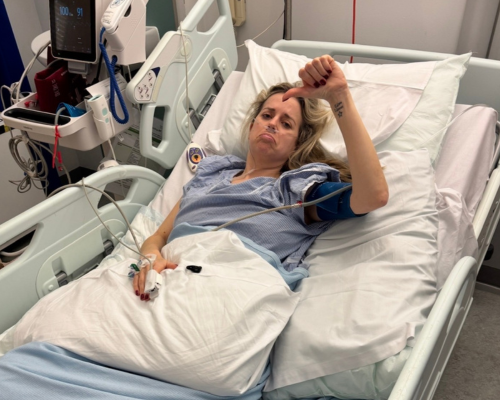
The next day I was given a sigmoidoscopy and a stenting procedure. The sigmoidoscopy identified a ‘malignant looking stricture’. The stents unfortunately perforated my bowel, leaving me in a life-threatening situation with four-quadrant peritonitis. I was taken into emergency surgery where my surgeon performed a complex bowel resection, gave me a colostomy and ultimately saved my life.
I spent the next 24 hours septic and have never felt so unwell in all my life. A couple of days later, the biopsy from the sigmoidoscopy confirmed I had cancer: stage 3, with a T4 tumour. I spent a total of 12 days in hospital, which was incredible really given how poorly I was.
Because my situation was an emergency and I was in survival mode, I felt quite numb when I was told it was cancer. They had been preparing me from the CT scan where they’d seen the ‘mass’. Once it was confirmed, I was so exhausted from surgery and being septic that it didn’t fully register. I think it hit me properly months later.
Undergoing chemo
After the emergency surgery I was discharged with instructions to try and get fit and well enough for chemotherapy. I’d lost a huge amount of weight and was put on a low fibre diet after surgery, but I knew I had to get eating again to build some strength back up.
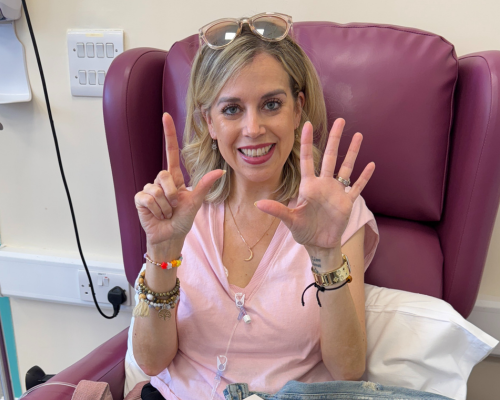
I was then able to start chemotherapy six weeks and four days after surgery. I was initially put on CAPOX but had awful side effects, to the point I couldn’t eat a thing or get off my sofa. It also caused me extreme bowel issues, severe neuropathy and depression. After two rounds of that, my oncologist moved me to FOLFOX. After two rounds of that we dropped the Oxaliplatin altogether as I was at risk of permanent nerve damage. I then did another seven rounds just with the 5FU pump which I tolerated much better. During those seven rounds I was able to go to school sports days and concerts, as well as trips away in our family motorhome, although I did have to take lots of naps and stay on top of nausea and other side effects.
Although I think I coped well overall, chemotherapy has such a huge impact on you as a person. I realised that friends and family couldn’t understand what it meant to experience fatigue and I found it frustrating when people compared their tiredness to my chemo fatigue. I have never experienced anything like it in my life. I felt low and fed up when the chemo and steroids affected my legs, making walks and days out difficult. And by the end I pretty much lost my sense of taste — as well as my fingerprints!
I found sharing my story on my Instagram page helped as I built a community of incredible people who were also going through similar experiences and it helped me to help others. There were times I thought I couldn’t take any more treatment, but every time I had those thoughts, I looked at my children and knew I had to carry on for them.
After treatment
Five months on from chemo I’m exercising five days a week, eating normally and back doing most of the things I love. My oncologist describes me as currently in remission, but I’m aware how quickly things can change. There’s been a question mark over a tiny nodule in my lung which is being watched. But other than that, I’m just having scans and bloods every three months.
I will also be in discussion with my colorectal surgeon about the possibility of a stoma reversal. But he’s already warned me that it will be major surgery for me. I’m not sure yet if it’s something I can put myself through.
Presently I am feeling well and positive. I haven’t returned to work yet as my work as a therapist requires you to be able to focus solely on the clients. I feel I’ve got a lot of trauma to work through yet, so I’m starting my own therapy imminently. I am also working on setting up my own cancer peer support groups, so I am keeping very busy!
I try not to think too far into the future. If this experience has taught me anything, it’s that life is incredibly short and precious and things can change in an instant. I was told that I had a 40% chance of dying in surgery. Since then, I’ve tried hard to be present and in the moment. But if I do look ahead, I see a life of cancer advocacy, seeing my children grow up to live their dreams and hopefully lots of travel to beautiful parts of the world.
So much support
My main support came from my wonderful chemo nurse, Sharon. I actually looked forward to chemo days because I knew the team would keep my spirits up and make me laugh. When I finished treatment Sharon made it clear that the team would always be there if I need to talk about anything. Initially after surgery, the cancer nurse specialists and my stoma nurse Chloe were incredibly supportive and gave me lots of help and information.
The support I needed from family and friends was both practical and emotional. When you have children, they need picking up from school or taking to hobbies and generally need to be looked after. I couldn’t do any of this for a few months. Thankfully my wonderful parents were able to step in, despite being in their 60s and 70s.
In terms of emotional support, I really needed people to listen, not minimise and not overload me with their own issues. I have some incredible friends who were wonderful — they checked in regularly, listened and sent me daily or weekly words of encouragement, often at times when I couldn’t even reply.
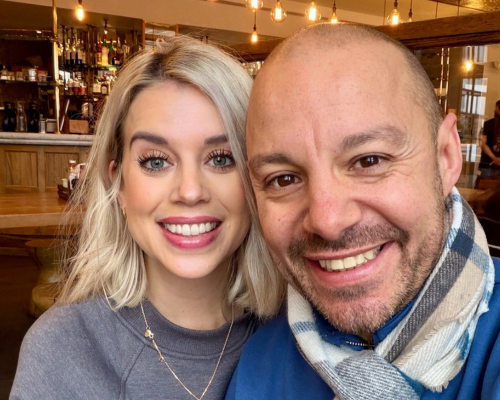
My biggest support came from my husband Jay. He took on every single job in the house and was amazing. He’s also been to every single appointment and been the person I’ve turned to when I've needed to cry and scream. He did all this while showing up bright and cheery on the radio every afternoon, taking just three weeks off in the beginning.
I got a lot of information about chemotherapy protocols and side effects by looking through old Bowel Cancer UK forums. I’ve also found the website informative, and the Instagram account made me feel less alone at times, especially the real-life stories.
Tips and final message
My biggest tip for friends and family is to offer specific support, like saying you’ll pick children up from school, drop round a meal, take you to an appointment, etc. Simply saying ‘Let me know if I can help’ is actually counterproductive and most people won’t ever do that! Specific offers with time and dates really help. I also think you can’t underestimate a card or a handwritten letter. A friend from university wrote me a letter after my hospital stay and it meant the world to me.
I think my biggest message is that you’re never too young to get bowel cancer. That doesn’t mean to say that if you have some symptoms, you automatically have cancer. Please don’t be scared. But equally if you do have symptoms and a pattern is starting to emerge, go to your GP. Keep pushing if you’re not happy with the care. My surgeon told me that the only real way to know what’s going on in the bowel is by having a colonoscopy. A half-hour test could save your life.