Pete Hill, Hertfordshire
I was diagnosed with stage 2 bowel cancer, aged 64, in 2022.
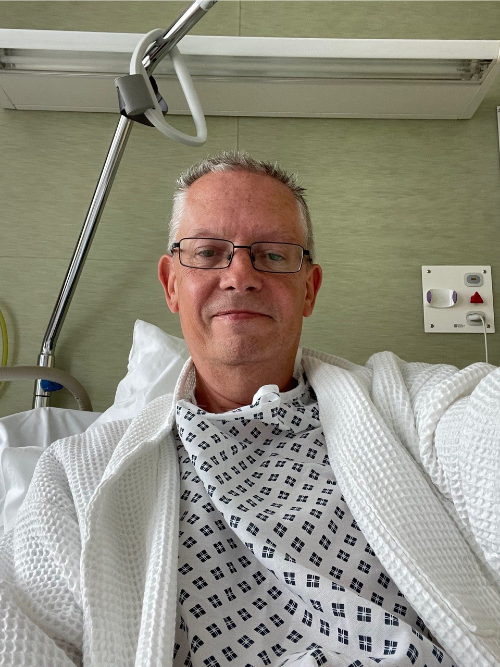
In 2022, my bowel habits changed suddenly, which caused me some concern. I then noticed some blood in my poo, which prompted a visit to the GP. He gave me an at home test kit, but before I could return it, I had a significant bleed and attended A&E.
After examination by three doctors across three visits, I was sent back to the GP with no conclusive results. That prompted me to seek a private consultation, which produced a colonoscopy, which resulted in my diagnosis that was confirmed by subsequent MRI and CT scans.
In a way, I was relieved as it explained what had been going on. Obviously, I was concerned, but I had 100% confidence in my consultant and my surgeon. Their professional and empathetic manner went a long way to putting my mind at rest.
I had an operation to remove the tumour in my lower bowel in June 2022. The operation was successful, and subsequent examination of 24 lymph nodes showed no spread.
Due to the position of the tumour, I had a temporary stoma bag. To be honest, in the initial stages, that was the biggest issue. I had no knowledge of stoma bags before and struggled for some time with the change in diet associated with it, and gaining enough confidence to leave the house.
I was relieved that it appeared the cancer hadn’t spread, but was advised by my oncologist that I could opt for a course of ‘mop up chemo’ delivered in tablet form to give me an even better chance of having a recurrence. This began in October 2022 and caused some initial problems with my stoma, which resulted in two short trips to the hospital to stabilise things. Thankfully, the chemo had little other effect, and with the help of the local stoma nurse and some counselling provided by MacMillan, things returned to the new normal.
One piece of advice I was given was to name my stoma bag. At first, I thought this was crazy, but I called him Cliff, and suddenly it was easier to talk about things with friends and family. I had a reversal operation in May 2023 following one false start, which occurred because of a buildup of scar tissue. When Cliff finally departed, he got plenty of goodbye messages on social media from friends and family.
My main coping mechanisms after a rocky start were humour, the realisation that I was the boss as far as Cliff was concerned, and realising that whilst I would never be the same person, I could, in fact, come out of it all a better person. That said, I couldn’t have done it without the unstinting support of my family and friends.
I’m now ‘under surveillance’ with six-monthly scans and blood tests, along with biannual colonoscopies. Three and a half years in, I’m optimistic about the future and feel I’ve learned a lot about myself. I certainly now realise I’m tougher than I thought I was. It is a new normal; it does need managing in terms of diet, portion size, and time of meals, but, provided I follow the routine I’ve fallen into, life is fine. I now do everything I did before my diagnosis.
My medical team were amazing; my surgeons, nurses and physios. They were very easy to talk to and kept me informed with everything I wanted to know. This is also the case with my oncologist, whom I can’t rate highly enough. Having already mentioned my stoma nurse, she was an unsung hero in the whole process, and no question was too stupid.
As I was retired, I thankfully didn’t have to concern myself with paid employment. That said, the organisations I volunteer for were brilliant, allowing me to work when I was up to it and covering for me when I wasn’t.
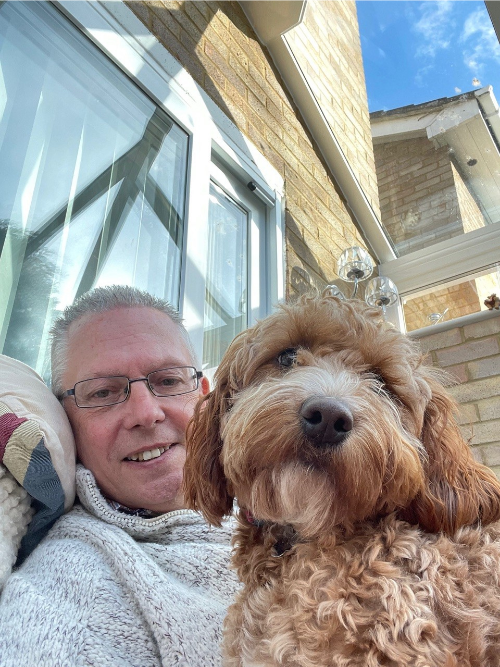
My family were in my corner all the way. I must admit some friendships have changed as people react in different ways; some went above and beyond, others were the opposite. It's something I have come to accept with the ‘new normal’. I was also fortunate to have a friend who had gone through the same situation two years earlier, and her advice was invaluable. As expected, my dog Benny stuck to me like glue once I was home from the hospital.
I’m a volunteer with Bowel Cancer UK talking to people who have had a diagnosis for their peer support line. The ability to talk to someone with lived experience is so important. I have recommended the charity to everyone.
For those going through a similar experience, don’t underestimate how tough it is, but also don’t underestimate how tough you are. Let the medics perform their miracles; your job is to maintain the right mental approach. Don’t be afraid to talk about it, you’ll find a lot of people will be put at their ease if you do. Someone said to me at the beginning, ‘Remember this is a marathon, not a sprint.’ I took that literally, and every day that passed, I imagined myself further around the course. I’m now in the stadium and looking towards the finishing line.