Jim Farebrother, Worcestershire
I was diagnosed with bowel cancer on 1 June 2010. I’m pleased to say I'm still here.
I’m blessed with a close family including three children, now all grown up. I’ve been married for 53 years. I was a probation officer, and my wife was a registered nurse. We’ve lived in Worcestershire for all but six years of our life together, but we both originally came from the coast. We didn’t have any health problems and enjoyed regular exercise like swimming and walking, ate a varied diet, and were moderate in our alcohol use.
My father had died from bladder cancer aged 66, but he was a heavy smoker. My sister had developed leukaemia in her 20s, and after two successful bone marrow transplants from my younger brother, she was enabled to have some longer-term quality of life. So, like most people I was acquainted with cancer.
My diagnosis
I did the routine poo test in early 2010 which led to a colonoscopy and diagnosis of rectal cancer on 1 June that year. I still remember the surgeon asking me if I was alright after giving me the diagnosis and telling him ‘No’ – I was not alright. He then left the room. I don’t recall what stage the cancer was at. All my certainties, confidence, and assumptions about the future collapsed. My family were, as always, wonderfully supportive and it was a great help, if also ironic to be married to a chemotherapy nurse.
The next few weeks were a bit of a daze, but three things happened. After a meeting with the surgeon and nurse the treatment plan clicked into place, and I began chemotherapy tablets. There were also scans and 25 sessions of radiotherapy. My employers were very helpful, and I was able to go on sick leave until things stabilised. Somehow, I developed the mindset that I had to face head on what was going to happen. I remember saying this to work colleagues and managed to keep it in mind as I went through treatment. Fear the worst and hope for the best!
Undergoing surgery
After being told that the chemotherapy and radiotherapy had shrunk the tumour, I went into hospital on 3 October 2010. I didn’t come out again until 13 December. The initial surgery went well but eight days later there was an internal leak, and I went unconscious because of sepsis. What followed was a further operation, weeks in intensive care – including being near death at one point – and then a slow re-emergence. I don’t remember very much about the worst bit because I was out of it. My family had to cope with that. They were told that my good level of fitness from regular swimming had helped me to survive.
There was a long period where I was being nursed and helped to recover. My wife visited every day and my children came when they could. I remember spending days staring at the ceiling at the hospital sometimes, dreaming about a glass of ice-cold water that I desperately needed to drink, which I couldn’t do because of a tracheostomy and oxygen pipe. There were also some funny moments such as bizarre drug induced hallucinations. For example, I decided that I’d be alright if my hands could reach each other (I could hardly move them) but my left hand had developed a phobia of my right hand! As it turned out, I did end up alright.
During my treatment I met some kind, compassionate and lovely people. The intensive care staff got me through the worst bit. The high dependency unit staff helped me get through the next hurdle and onto a general ward. Meanwhile, the physiotherapists had me moving about from small beginnings soon after I regained consciousness. I had to relearn to walk. I had contacted the hospital chaplain before going into hospital and found comfort from the chaplaincy volunteers who came round. Friends and colleagues from work sent cards and I felt well supported and encouraged.
A slow recovery
I returned home just before Christmas 2010 and it took several months to get back to reasonable health. I was able to take redundancy from my job as it was clear that I could no longer do it, but I’d still have an income.
In the autumn of 2011, I answered an advert for volunteers to help support victims giving evidence at a local court and was accepted. This made use of my professional experience, helped me to focus on something important and worthwhile, and helped me start rebuilding my confidence. I later also volunteered at Citizens Advice which I’ve continued to do. This has enabled me to contribute to others, use my brain, and feel worthwhile.
I’ve also done my best to keep fit by attending a gym and enjoying walking. My operations have left me coping with a colostomy that couldn’t be reversed. I was well taught by the stoma nurse and have now managed it for many years by being organised and methodical.
I had survived and what followed were routine appointments, occasional colonoscopies, and scans. I was able to reach acceptance of the disease through internal strength that emerged from a mixture of not taking life for granted, recognising that cancer can happen to anyone, and being grateful for surviving. Speaking to people who had faced and managed other conditions also helped. Being realistic, as well as positive with a sense of humour about it all, helped too.
I’ve also been lucky. I’ve met all four of our granddaughters, two of whom are now teenagers.
Further issues
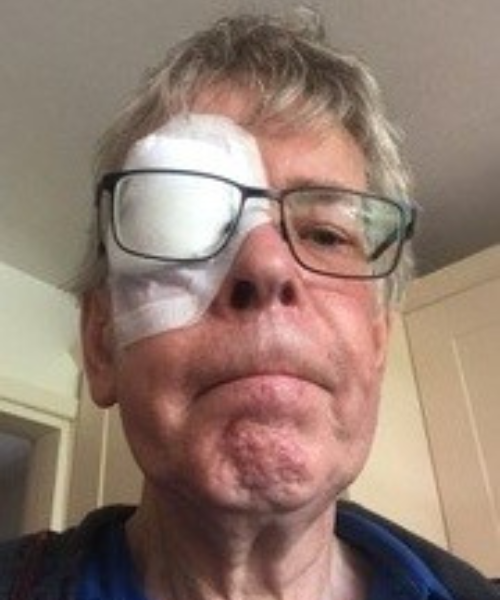
I’d been experiencing a sore eye for a long time but was told it was blepharitis (eyelid inflammation). Then in late 2021 I was diagnosed with a sebaceous gland carcinoma in the conjunctiva in the corner of my eye. This was another massive blow. There followed biopsies, scans and a first operation to deal with it, hopefully saving the eye. Unfortunately, that didn’t work. On the advice of two surgeons, I opted to lose the eye to have the best chance of a cure. The operation was in May 2023 and only required an overnight stay in hospital. I remain clear of recurrence and on yearly follow up. The surgeon that I had and her staff were the best that I’ve ever experienced. I have a realistic ‘eye’ made by the equally wonderful prosthetics department in Birmingham.
The eye treatment included a referral to genetic health to check for Muir Torre (Lynch) syndrome, a hereditary condition which I’d never heard of. Bowel Cancer UK information helped me to understand a bit more about this very worrying development. Having been lucky to live near a regional centre of excellence for eye surgery, I was again lucky learning that I wasn’t going to pass anything on to my children. This was all handled very sensitively by the genetic counsellor.
During the eye treatment, a scan had revealed a small tumour in my bladder. This was dealt with by laser treatment in October 2022 and I’m now receiving half yearly cystoscopies to check for recurrence. The same scan also indicated the possibility that something was going wrong in my intestines but that proved not to be the case.
Learning to cope
I’ve managed to get through this sequence of extra tribulations with the support that I have. It was a case of trusting the medical staff whilst they go about their work. I’ve developed resilience that I can rely on, and a phrase that I got from a man with Parkinsons disease has helped me too: ‘It lives with me; I don’t live with it’. Though it’s hard when there’s more terror to face and you wonder what else is going to go wrong, slowing down and taking it bit by bit can help.
I continue to rejoice that I’m still here. I sometimes wonder if I’ll ever get out of the bathroom in the morning with various body maintenance tasks that I have to perform – my cancer ‘record of achievement’ has filled up with more things to do over the years! Sometimes I forget to put my eye in, like when I went to breakfast minus the ‘eye’ at the hotel we were staying in. A staff member kindly helped me to open my cereal packet without the flicker of a concern! There was me feeling all embarrassed when I realised I was eyeless. There are small moments when you can laugh about the absurdity of it all.
Thankfully, sebaceous gland carcinoma is rare. If you’ve had bowel cancer and you get persistent soreness in one eye, but not both, get it checked. The other thing I’ve learnt is that there is always someone worse off than you are.
I hope that my thoughts on how I’ve coped will be helpful to you in some way. Best wishes.