Jane Short, Glasgow
I was initially diagnosed with bowel cancer on 31 July 2025. After further scans, I got my full diagnosis of stage 4 bowel cancer in August 2025.
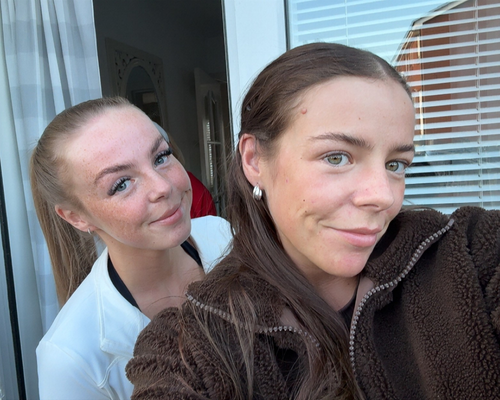
I was brought up in the 1970s and am now a mum to two grown-up daughters. I’m a physio support worker, which I’ve recently returned to after extensive treatment for bowel cancer.
My diagnosis
I received a bowel cancer screening kit around my 50th birthday. Unfortunately for me, I didn’t do the test. I can’t justify why, but it’s a major regret. Two years later, I experienced urgency to go to the toilet and bleeding. I did the FIT test then and received the result that further investigation was required. Within two weeks I had a colonoscopy and immediately a tumour was detected.
After the colonoscopy, a CT of my chest abdomen and pelvis showed two tumours in my liver. I then had an MRI of my liver and a PET scan which discovered six tumours in my liver. At this point the liver tumours were inoperable due to their position, and it was decided that I’d start chemotherapy to give me the best outcome and the possibility of being suitable for surgery. It took roughly eight weeks for a full diagnosis from my colonoscopy.
I felt a lot of emotions about my diagnosis: shock, despair, sadness, and fear. I had no indication that my diagnosis would initially seem so bleak. I cried a lot and was so angry at myself for not completing the bowel screening test two years previously, as my cancer could have been caught at an earlier stage.
Undergoing treatment
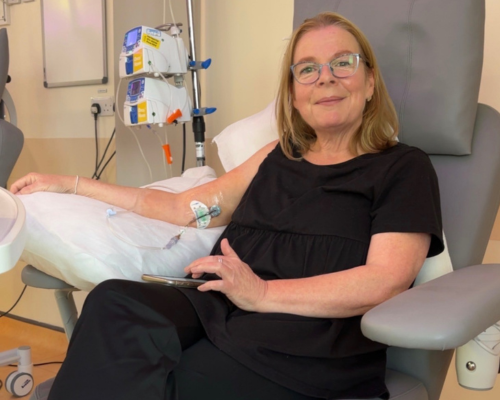
I had eight rounds of chemotherapy and targeted therapy. I had a chemotherapy pump that I wore for 46 hours that was connected to my PICC line. That allowed this part of treatment to be completed at home. After regular scans, I got the fantastic news that I’d responded well to chemotherapy and was now a candidate for surgery three weeks after my final chemo.
I had surgery to remove all my tumours: a right hemicolectomy, a liver resection, and my gallbladder, and 13 lymph nodes were removed. Chemotherapy was tough but manageable with support from the colorectal nurses, who helped dramatically with side effect management. The surgery had a huge impact on me – it was probably the first time I’d felt unable to do normal everyday things, but I’m and will forever be grateful that I got the opportunity for surgery and treatment.
‘I’m grateful to be here’
At the time of writing, I’m 18 weeks post-surgery. It was successful and I required no further chemotherapy. I’m now on surveillance of an MRI and CT scan every three months for the first year as I have a very high chance of recurrence. However, I’m doing well and have recently returned to work, which a year ago I didn’t know if I’d be able to do.
The fear of recurrence is real and makes it difficult to look into the future, but I’m super grateful to be here and well. I’m hopeful that it will stay this way for a long time to come.
The support I had
I received excellent care from colorectal nurse specialists both in the surgical team and the oncology team. They were at the end of the phone if I had any questions or concerns and kept me and my family fully updated throughout. After my surgery, the medical team called my daughter to update her, and they took the time to call when my scan results meant I was a candidate for surgery. I was praying for positive news, so getting this support from the medical team was reassuring.
I received lots of Bowel Cancer UK information booklets from my surgical team. They were so informative, explaining the impact of surgery, dietary changes, and what to expect after surgery. I relied on them a lot. My family were supportive: my two daughters managed admirably while dealing with the fact their mum had advanced cancer. They were so strong even when the outlook was so bleak.
My main message
Getting a cancer diagnosis was probably the worst thing that has ever happened to me – knowing that I’d had an opportunity to be screened and didn’t take it will haunt me. I couldn’t bear the thought that I might not be around to see my daughters get married or get the chance to become a granny. If I can encourage just one person to do their screening test, then that’s ideal. It literally saved my life.