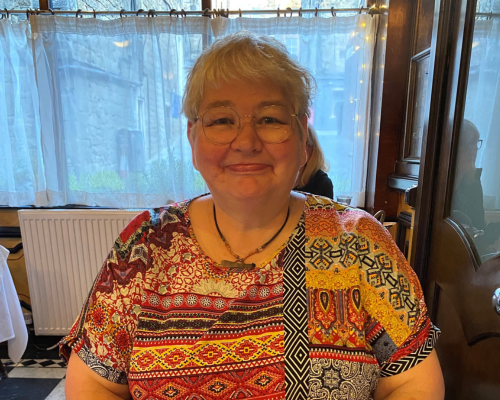
Helen O’Leary, Abergavenny
I was diagnosed with stage 3 bowel cancer on 3 December 2024, aged 57.
I was born in the north of England and grew up in the Forest of Dean, Gloucestershire, and Papua New Guinea in the South Pacific. I now live and work in South East Wales as a nurse. I'm a widow — I lost my wonderful partner five and a half years ago to cancer. I miss him every day. Cancer has touched me in many ways, personally and professionally.
Diagnosis
I’d had an altered bowel habit for a couple of years prior to my diagnosis. I put it down to stress after caring for, and losing, my partner, and then my dad — all within a 10-month period. I was seeing my GP who started treating my symptoms. Cancer wasn’t on my radar.
In October 2023 I had my first FIT test as I was 55. This came back negative. In May 2024 I went back to my GP as my symptoms were continuing. He escalated things and I had a blood test and another FIT test. My bloods showed I had iron deficiency anaemia and the FIT test was positive. I had a telephone assessment with a specialist nurse who put me on the urgent suspected cancer list and told me I needed an urgent colonoscopy and endoscopy. I had these in June 2024.
The colonoscopy showed a very large polyp in my sigmoid colon — I remember seeing it on the screen and thinking ‘That shouldn’t be there’. The doctor told me that polyps that size are normally cancerous. He took biopsies which came back as normal. I had a CT scan and MRI scan that week.
The polyp had to come out so it was decided they would try and remove it during a colonoscopy procedure. This happened in August 2024 and it was determined that it could not be removed this way. The doctor told me I had diverticulitis which was responsible for my symptoms. He took more biopsies which again were negative. I then saw a colorectal surgeon and had my surgery on 5 November 2024.
I had an anterior resection which removed a large part, if not all, of my sigmoid colon and part of my rectum. I didn’t need a stoma. I was told it would take four weeks for the biopsy results to come back and that I wouldn’t get a call if the biopsies were normal — so I knew if the colorectal nurse phone number came up on my phone that it was going to be bad news.
I was at home, on my own, on 3 December 2024 when they rang to say I had cancer and that I would need chemotherapy. They’d taken 30 of my lymph nodes and one had tested positive, so this meant I had stage 3 bowel cancer.
I had been repeatedly told by just about every healthcare professional that I met that I should prepare myself for a diagnosis of cancer. I lived with that for six months, which was incredibly hard. It is also incredibly hard to prepare yourself for a cancer diagnosis.
When I heard the words ‘You have cancer’, I felt relieved — I now knew. There was also fear and anxiety, but predominantly relief.
Treatment
I saw an oncologist the following week at a specialist cancer hospital. Chemotherapy started in January 2025 and finished in April 2025. Chemotherapy absolutely terrified me. Physically, I knew it was going to be tough, but there is a lot of information about what to expect and 24-hour telephone access to specialist nurses if you have any concerning side effects — that was very reassuring. I also knew that the physical side effects were temporary.
Nothing prepared me for the effect chemo had on me mentally. I expected some anxiety and low mood, but I didn’t expect nightmares and flashbacks to previous trauma. No one spoke about that. I thought I was having a mental breakdown, that I was going mad.
I found out, months after chemo finished, that there is a well-established link that a cancer diagnosis can trigger past traumas. A psychologist at Maggie’s told me this. I wish I had known this at the time. I wish someone had asked me how I was mentally — it's a difficult subject to bring up as I felt embarrassed.
I started seeing a psychologist privately just after chemo finished. I'm still seeing them. It's incredibly helpful having that support. I'm aware that there is psychological support through the NHS and through cancer charities, but there was a waiting list to see them. I felt my mental health was deteriorating so sought private help.
The aftermath
My treatment is finished now. I’m on a three-year screening programme. Every six months I have a blood test for tumour markers. I also have a yearly CT scan and a colonoscopy at one-year post-diagnosis and in the third year. This screening programme is fantastic, but it's very hard waiting for test results and being uncertain about your future. This is the reality of living with cancer.
These last few months I feel my life has been on hold, waiting for tests and subsequent results. I feel I've not been living but existing. That has stopped now and I'm living again because I refuse to just be existing. I've made plans and I feel excited for the future. I've returned to work as a nurse, which I am enjoying. It was hard being a patient, but I hope the experience has given me more compassion and empathy for my patients.
As I've finished treatment people think you're okay. I'm not. I still suffer with fatigue. I'm trying to balance energy for work and energy for outside of work. I haven’t got the balance right yet. I still struggle, at times, psychologically.
I often think back and try and process what has happened. During treatment you just cope with what's happening day by day, hour by hour. For me it was only when treatment finished that I started to think: ‘What on earth has just happened?’.
I’ve met some good people during all of this and have made some new friends, people who have bowel cancer like me. They know what it's like. We support each other in a way that people who haven’t had a cancer diagnosis can’t.
Support and my closing message
Medically there was 24-hour telephone access to the specialist centre — you could speak to a cancer nurse specialist. This was very reassuring. My GP surgery was great and met my needs 100%. My employer was very supportive during my treatment and supporting back to work.
I'm very close to my family, but not geographically. It was my friends who were physically there for me 24/7 during chemo. I'm eternally grateful for their love and support.
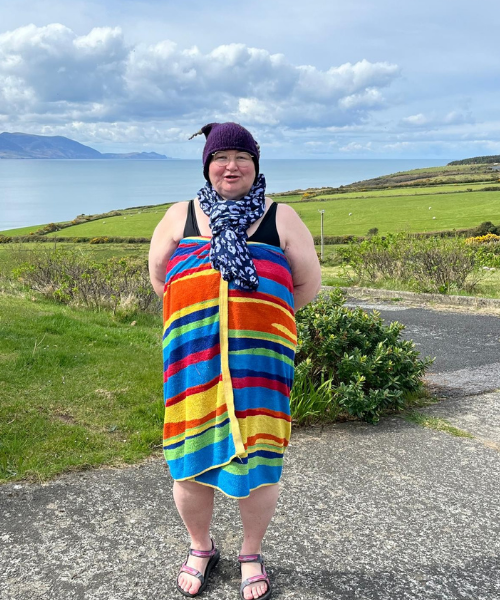
The week after chemo finished, I was whisked off to the west coast of Ireland to stay with family. This was fantastic, with home cooking and home comforts. The day after I got there, I was in the sea, jumping and diving through the waves screaming at the top of my voice: ‘F**k off cancer!’. It was exhilarating and overwhelming — I think it was the first time I had really cried. I was so fatigued my family had to peel my wetsuit off me — after helping me into the wetsuit!
I accessed information from the Bowel Cancer UK webpage before and during treatment. The information was very helpful and written in a way that was easily understood. I still use the webpage to keep informed of what is happening in bowel cancer world and to check information. I went to a half day event in Newport run by Bowel Cancer UK and this was very helpful.
My final message is that we all poo. Please do not be afraid to talk to a healthcare professional about your bowel habits — if something is not right or different, then please seek advice. My GP got the ball rolling for me and I'm extremely grateful for that. If you are sent a FIT test, then do it — it could save your life.
Following a cancer diagnosis, please look after yourself mentally — don't be afraid to ask for help. Tell your cancer team or GP that you are struggling and ask for help — there is help out there. Don't suffer alone.