Gemma Jameson, Oxfordshire
I was diagnosed with bowel cancer on 24 January 2025 when I was 27 years old.
In August 2024, I kept experiencing a hot sensation in my ankle and getting really bad cramp in my feet. I went to the doctor and they ran a blood test. It came back that I was B12 deficient and folate deficient, so I started on B12 injections and folic acid tablets. I stopped getting the feeling in my ankle and the cramp in my feet after this.
A couple of months after the injections I started to notice a mild stomach pain after eating. I would also often get a red eczema looking rash on my face which would come and go. By December, I was experiencing the pain more regularly, so I made a doctor's appointment. My doctor examined me but couldn’t feel anything, so decided to run more blood tests and requested a FIT test. The blood tests came back just before Christmas. They showed that I was iron deficient but not enough to be anaemic, so this could have been due to my diet. I was also vitamin D deficient. The doctor said he thought it could be IBS, but the FIT test hadn’t come back yet so we needed to wait.
The FIT test came back a couple of weeks later. I got a phone call while I was at work telling me it came back positive for blood and I would be put on the two-week cancer pathway for a colonoscopy. They told me not to worry as most of the time it doesn’t mean they will find cancer – it’s just the process they had to follow. I felt nervous for the procedure, but I never imagined they would find cancer.
My diagnosis
I had my colonoscopy on 21 January 2025 at a local hospital. The prep was awful, but I told myself it was a one-time thing. I don’t remember much from the procedure, but they started taking biopsies and tattooing the area. I remember feeling worried, but I still didn’t worry that it was cancer. I was told I would need a CT scan to find out more and just assumed it was because it was more difficult to remove. The nurse afterwards let me know I would be continuing the two-week cancer pathway for a CT scan but didn’t confirm it was cancer, so I thought it still wasn’t certain. That evening my GP rang me as he had seen the report and was shocked at what they found. I had not seen my report yet so hadn’t realised it was labelled as ‘highly likely to be cancer’. I assumed it would still be fine and my doctor was just shocked about the size of the polyp (60mm).
The next day, the reality started to sink in, and the concern from the GP started to worry me more. I was off work and rang my mum crying as I was starting to really panic. I got a call around lunchtime from an incredibly kind and considerate specialist nurse from Churchill Hospital, Oxford, who had told me that the report mentioned it was highly likely to be cancer. This came as a real shock, so I was quite emotional on the phone. She reassured me about our next steps and told me to look at the information on the Bowel Cancer UK website instead of Googling anything. That evening, I got a phone call to say my CT scan was booked in for the following day.
I was anxious and struggled to sleep that night. I just felt constantly sick and remember crying to my mum and partner saying I didn’t want to die. The CT scan was quicker than I thought it would be and that evening we drove to my parents' house in Cambridge. I was on edge all evening and the following day. I wasn’t sure how long the results would take, so I barely ate, and just kept going through scenarios in my head while reading people’s stories on the Bowel Cancer UK website. I knew if it hadn’t spread, then it was likely that it could be cured so I held onto that.
At around 5:30pm the next day, I got a call from the hospital. I went into the other room. My specialist nurse rang me to tell me she had my results and wanted to check whether I wanted to hear them now or at my next formal appointment. I told her I would like to know and had sat down next to my mum at this point. She said my results confirmed I had cancer. The good news was that it looked like it hadn’t spread and my lymph nodes didn’t look swollen. I started to cry and felt an overwhelming sense of relief. The nurse was so compassionate and let me know I would be discussed at the next MDT meeting on Monday. I would then meet with my consultant to discuss treatment.
My diagnosis was a complete shock as I was only 27 years old and the pain/discomfort I was feeling wasn’t intense and wasn’t stopping me doing anything. I imagined that having cancer would mean I’d feel horrendous all the time and would be in intense pain but that wasn’t the case. I only went to the doctor because my partner told me I should and because the pain wasn’t intense, I was worried about wasting their time. I was lucky my GP was so vigilant and requested that FIT test the first time I went for stomach pain.
My surgery
The following week I met my consultant and she talked me through the treatment. She explained that the first step would be surgery. I explained that my sibling has sessile serrated polyposis, and my surgeon wanted to do a colonoscopy herself to see if I could possibly have the same condition. In the previous colonoscopy they’d also found two small polyps, so it was possible I had the same condition. If it looked like I did, they wanted to remove more of my colon to prevent any recurrence. I just wanted it out, so I was not bothered if they needed to take more. They would not know if I needed chemotherapy until after the surgery, so I just focused on the surgery.
A week later I had my follow-on colonoscopy. It was determined that I would need an extended right hemicolectomy to remove the tumour in my transverse colon and the ascending colon where the sessile serrated polyps were likely to be. It was unlikely I would need a stoma, but it wasn’t certain. They also would remove my appendix as well.
My surgery was exactly a month after my diagnosis. In the lead up, I just tried to focus on building my fitness and preparing myself for the surgery. My consultant was extremely caring and understanding and I knew I was in safe hands. On the morning of the surgery, I was extremely nervous. My partner initially wasn’t allowed into the waiting area with me as it was a women’s only ward, so my consultant arranged for me to be in a side room with him until I went in. Her kindness in that moment was extremely appreciated. She could see I was nervous so she didn’t want me to be alone.
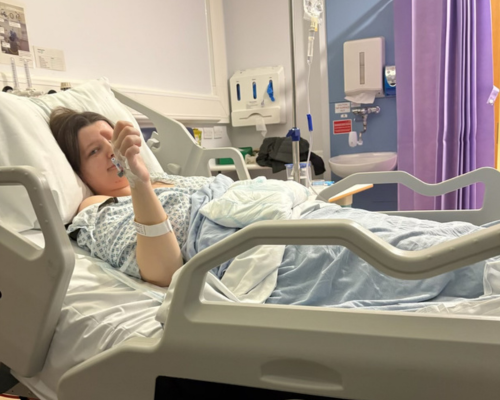
After 30 minutes, the anaesthetist came and brought me down to the theatre. I had a spinal block and cannulas put in, and then I was lying down. The last thing I remember is feeling like I had drunk a bottle of wine. The next thing I remember is coming round in the recovery room and feeling around for a stoma, but I couldn’t feel one. I was in a bit of pain, but not as much as I thought. My consultant came round to tell me that the surgery had gone well and confirmed I didn’t need a stoma, so I was relieved. I was eventually wheeled into my room where I got to see my partner and parents, which was a massive relief. I was tired after the surgery and was in some discomfort, but the pain killers helped keep the edge off. I struggled to sleep that night due to all the sounds and observations that were taking place, and it was extremely warm on the ward.
After my surgery, I initially struggled with standing due to my blood pressure dropping every time I stood up which was frustrating. The following day, I was put on antibiotics due to an infection and this helped me to start to feel better. I was determined to stand and go on small walks. I found my catheter uncomfortable, and I was able to have it removed. The next day, I was sick all over myself and felt like I had taken ten steps backwards. The doctors spoke about my needing a nasogastric tube, but this made me nervous and I was determined not to have one. I tried to eat some more soft food and focused on building my strength by going on walks.
By the end of the fourth day, I started to feel better. I struggled to look at my scars in the first few days following my surgery. I was nervous to see what it looked like and what my body now looked like. The following day, I managed a shower and was more confident walking around. I hadn’t been sick again and my consultant came to see me and said I was able to go home. I was so relieved, as all I wanted was to go home and sleep in my own bed. Time goes slowly in hospital – it can be frustrating, but you just have to take each day as it comes.
The following weeks after surgery I took my recovery slowly. I went on short walks every day and slowly built up the distance over the next few weeks. I slowly also got used to my scars and adjusting to what my body now looked like. After three weeks, I got a phone call from my specialist nurse to let me know that they had the results from the lymph nodes. Out of the 63 they removed, three were showing to be cancerous, meaning I had stage 3 cancer. I was therefore being recommended for adjuvant chemotherapy to help prevent reoccurrence. I was really scared about chemotherapy and put it to the back of my mind when recovering from surgery, but I knew if I was offered it, I was going to take it.
Going through chemo
A few days later, I was meeting my oncologist, who again was kind and empathetic. She talked me through what chemo I would be on (CAPOX), how it would work and the side effects. I was mostly nervous about the nausea but was reassured I would be put on anti-sickness drugs to help combat this. We also spoke about fertility and how chemo may impact my fertility, so I was referred to the fertility clinic for egg freezing. Even though the risk was low, they didn’t want to risk it. Egg freezing happened quite quickly and the whole process was relatively smooth. I managed to freeze 31 eggs which I was grateful for. Overall, I was nervous for chemo but wanted to give it everything I had to ensure the cancer did not come back.
I was on CAPOX chemotherapy for four cycles. It was an infusion on the first day, then 14 days of tablets, then I got one week off before the next cycle. My first chemo session was one week after my egg freezing procedure. I was anxious for the first one especially sitting in the room with other patients. It was really intimidating, but everyone was super friendly and smiley which put me at ease. After the infusion, I felt OK, just a little sleepy and lightheaded. Once I got home, I started experiencing neuropathy – where your fingers and toes tingle when you touch anything cold. I managed to eat some dinner and take my tablets and went to sleep.
For the first few days, the symptoms weren’t as horrendous as I thought. It was mainly tiredness, brain fog and the neuropathy. However, after the first three or four days, I suddenly felt extremely down, and everything hit me at once. I was crying all the time and found it hard to concentrate. After the first week I started to pick back up again and felt more like myself. On the week break, I felt great and tried to enjoy the week as much as possible.
The second cycle was harder. I got throat spasms due to the cold air hitting my throat on the way home from the hospital, and I felt like I couldn’t breathe, and I couldn’t speak at all. It was incredibly scary and I was nervous it would happen again. Once I got home, I steamed my throat and started to feel better. Seven days into the cycle, I started to experience diarrhoea that wouldn’t improve with medication. After a night spent in the hospital, it was decided that I should pause the tablets and my oncologist would call me the following week to decide on next steps. On Monday I spoke to the oncologist and we agreed to stop this cycle and reduce the dose for the tablets on the next cycle. I started to feel better over the next two weeks and was nervous for the third cycle but also relieved I only had two cycles left to get through.
On the third cycle the lower dose of tablets helped. However, I was experiencing nausea daily and struggled with eating. I managed to get through 12 days of the cycle until I was sick, and my oncology nurses recommended that I stop the cycle again. I felt defeated, but I felt pleased I managed to get further along this time.
The day before my fourth cycle was due to begin, my nurse explained that my platelets were low so I’d need another blood test at the hospital before I had the treatment. Unfortunately, the test showed they had dropped further so I was unable to go ahead with the treatment. I was gutted as I just wanted to get it over and done with, but I was also grateful to give my body an extra week to recover. That week I was going back and forth on whether I should go ahead with the final cycle or not. I felt my body couldn’t take anymore, but I also didn’t want to not do it and for the cancer to come back. I decided I would speak with the oncologist and go with their advice.
My oncologist rang me the day before and asked me how I was feeling. I talked through how my body was feeling and she said that unless I felt strongly, I shouldn’t go ahead with the final round as I’d already done the majority of it and it wasn’t worth putting my body through anything further. I agreed and felt such a relief.
You’re often told with CAPOX that it is a ‘mild’ chemotherapy and you should be able to carry on as normal. However, everyone reacts differently, and my oncologist said that she finds the younger you are the more you struggle. This made me feel less like a failure. A few weeks after chemo I still struggled with low mood, fatigue and brain fog, but slowly I started to feel better.
Where I am now, and my main message
At the time of writing, I’ve just had my one-year blood test, colonoscopy and CT scan. They’ve come back all clear which is a massive relief. I think cancer changes the way you look at yourself and life – I look back at pictures of myself from before my diagnosis and I struggle to recognise myself. You don’t think anything like this will happen to you, especially so young. You have a greater appreciation for life and how precious it is.
My focus now is to continue building my fitness back up and ensuring I am as healthy and happy as I can be. I still deal with anxiety for scans and I'm still processing everything that happened to me after focusing on getting through each day of treatment. It feels like a new chapter and my partner and I are looking forward to getting married this year.
My medical team was fantastic – they all showed incredible kindness, empathy and compassion. I couldn’t be more grateful for the support they showed me; it made such a difference. The specialist nurses are an incredible support as they answer any questions and talk through any concerns that you may have.
My family and friends were also incredible and with my every step of the way. I think sometimes it was harder for my partner and parents to watch me go through everything, but they were always there to talk through how I was feeling and encourage me when I was feeling low. I wouldn’t have been able to get through it without them. I worked throughout my chemo treatment, and my line manager and team were incredibly supportive. I was lucky I was able to work from home throughout it.
The stories on Bowel Cancer UK’s website really helped me when I was initially diagnosed. They reassured me that I wasn’t going to die and my cancer could be treated. It also helped that there were stories from other young people that I was able to relate to. The information the website has on treatments was helpful as I read through them prior to my appointments with my oncologist and consultant. My family and partner also used the website to find out more about what I would be experiencing. I highly recommend it to other patients, their friends and family especially in the early stages of diagnosis.
The main thing that I found difficult was being diagnosed young. I was always the youngest one on the ward after surgery or on the oncology ward and it was hard to relate to other people as I didn’t see anyone a similar age to me. That’s why the real stories were really helpful, especially reading that others had also gone through fertility preservation. It wasn’t something I ever expected to have to consider.