Chris, West Sussex
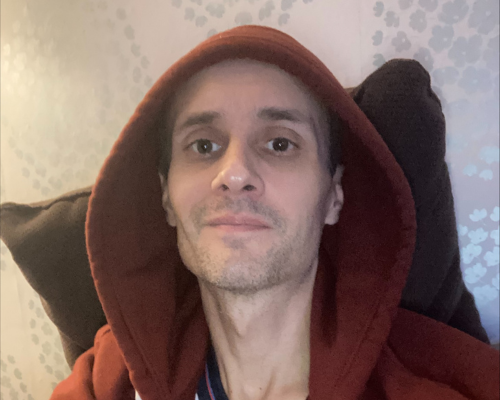
I was diagnosed with bowel cancer in November 2022 aged 39 after years of experiencing symptoms.
My journey began during COVID when I experienced dull aches and pains in my stomach and had a lot of bleeding when I went to the toilet. My mum said at the time that our family had a history of haemorrhoids and it was probably that. I called my GP, but they were not really seeing people during COVID. They asked me cancer screening questions – I didn’t realise at the time – and prescribed me a suppository which stopped the bleeding and made the pain go away.
Fast forward to early 2022. My dad who had cancer for eight years wasn’t very well and my mum had just been diagnosed with stage 4 lung cancer a few days before Christmas. I was also stressed at work. I started getting horrible excruciating stabbing pains in my abdomen, like I wanted to dial 999, as well as the dull ache low down I had years before. I thought it was all the stress and worry and it would subside and come back.
My parents started doing better and I was not as stressed, yet the pains kept coming and were getting worse. I went to the GP that summer around May or June. The GP did a rectal exam and said I had an internal haemorrhoid. He also felt my abdomen and asked me cancer screening questions — again, I didn’t realise that at the time, but my symptoms were otherwise explainable. They’d also done blood and poo tests and said I’m normal and healthy. The haemorrhoid explained the dull low pain, but not the one in my abdomen. The GP said to come back if the pain in my abdomen persisted.
I did go back multiple times. I started going to the toilet less and being sick a lot. The doctors put me on a low FODMAP diet and thought it might be IBS. They did more tests. I carried on being sick and going to the toilet less as weeks and months continued. I also started sleeping less due to the pain. I was so ill around that October that I went to the hospital and was bringing up food I’d eaten several days ago. The doctor in the hospital said I’d been prescribed a new anti-sickness tablet the day before by my GP and sent me home. I went back to the GP and they said it was probably my healthier diet, despite my explaining that literally nothing was coming out at all.
‘Something is desperately wrong’
On 16 October after weeks of no sleep, I woke up and felt like something was desperately wrong. My gut feeling was that I was dying. A friend dropped me off at East Surrey Hospital. I had an X-ray then a CT scan. I was told I had a growth blocking my large intestine and they needed to do an emergency operation within the next few hours. Hours later, I had an emergency extended right hemicolectomy that removed close to four-fifths of my large intestine and 56 lymph nodes. Sadly, the operation failed and the join leaked. I spotted a rancid liquid leaking out of a drainage wound that turned out to be poo. The team saw this and told me I needed another emergency surgery five days after my first, as if I didn’t have sepsis now, I would shortly, and I’d be dead in two weeks if they didn’t operate. Failure was not an option.
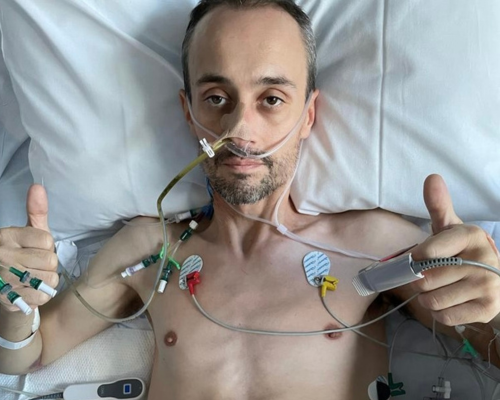
The second op resulted in a temporary stoma. I was desperately ill, severely underweight and had a severe infection. I spent 39 days in hospital and was an awake vegetable for part of it. I was fed through a tube in my neck before having a PICC line inserted in my arm. I tried to eat as I started to improve, but I kept feeling sick as my stomach wouldn’t wake up, so they kept sucking the food out of a nasogastric tube. It was tough going.
Finally, a diagnosis
Around three weeks into my stay in hospital, I was diagnosed with bowel cancer. I remember a cancer nurse coming in first saying they had my results. It was surreal. I looked at my wife and said: ‘That’s not good that a cancer nurse has said that’. The surgical team said they had cut everything out but recommended mop-up chemotherapy. I promised my wife I was not going anywhere and wouldn't leave my three-year-old boy and one-year-old daughter. I promised her I’d throw the kitchen sink at it and do everything I could to try and get well.
After my diagnosis, I focused on putting on weight, trying to eat and move again, as I had lost a lot of weight, muscle mass and strength. Initially I was like a bedbound old man. Slowly I made progress. My infection markers dropped and I could eat and move. I was discharged from hospital in November 2022 after 39 days. Nurses visited me at home to help change my surgical dressings and I rested, ate and tried to put on weight, knowing chemotherapy was to come.
My progress was slow, but I was making progress. I remember it took me an hour and a half to wash myself at first. I had aLynch syndrome test, which was all clear which was a relief. I met my oncologist in December and she recommended at least three months of FOLFOX chemotherapy, with the possibility of an additional three months. I found out my tumour was very large and had blocked my large bowel and grown out the other side. It had also gone to local blood vessels, nerves and lymph nodes, but luckily hadn’t spread anywhere else in my body. I was still very underweight, and my surgical wound hasn’t fully healed, but the oncologist wanted to get me on the chemo ASAP and not waste any time. She said it’d be hard going for me.
I started my chemotherapy on 23 December 2022. FOLFOX was hard going. My wife and friends drove me to chemo. I had to dress up warm as I felt cold a lot. I got neuropathy in my hands, fingers and face. I had to avoid all fizzy drinks, cold food and cold drinks, and it wasn’t nice to touch cold things or touch cold water. My taste buds changed and anything vinegary and similar tasted awful. I also felt very nauseous a lot but wasn’t sick. I had to take steroids and anti-sickness tablets. I generally felt awful for 7–9 days. I also felt what I call the ‘chemo blues’, a depressed feeling that went away after 9–10 days, before starting my next session a few days later. The sessions were every two weeks.
At the three-month mark I had a clear CT scan. I asked my oncologist to do the next three months of chemo. I said I wanted to do everything possible to give me the best chance of living hopefully a long healthy life and the best chance of staying in remission. The second six sessions were pretty hard, especially the last three. My platelets dropped, so I had to delay treatment for a week and inject my thighs to boost my cell count so I could resume treatment. Generally, I did well and put on weight during treatment and tried to remain active.
I completed my treatment in June 2023. All my CT scans have been clear since, including a recent one in December 2025, three years after my diagnosis in November 2022. I had a clear three-year colonoscopy in January 2026. I also had my stoma reversed in February 2025. I’ve gone back to work full time and have been doing physio to aid my recovery. I do pretty much everything I did before my diagnosis and lead a very normal life.
My advice
If you’re reading this and are similar to me, facing cancer at a young age and living with a temporary stoma, it was tough, but you adapt. Break things into small steps. Take things day by day, week by week and try not to overthink things. Also, try to see the wins along the way as they lift you on the tough days. The journey is full of surprises. Don’t read Dr. Google as everyone’s journey is different. Friends you’ve known for years drop off the face of the earth and only send you one text message. People don’t know how to talk to you or what to say. People feel awkward. They don’t mean you any ill will and wish you the best but simply don’t know to respond to the situation. It’s important not to take it personally. Other friends and people you don’t expect go out of their way to help you in a way that touches, surprises and lifts you up and makes you feel loved and supported. On the journey, you'll find a well of strength and sheer determination within you that you never knew you existed.
I also realised how important mental health is. The physical and mental scars stay with you long after treatment has finished. It’s important to be real and authentic. It’s good to have a positive mindset, but it’s so important to feel all the emotions you are feeling and let them happen. Don’t bottle them up. Be real with yourself. Also, during treatment, if you’re unwell, use the word ‘No’. If people invite you to things and you don’t feel good, be honest. Say you need to rest. Don’t be a people pleaser — your health has to come first.
Journaling and counselling are helpful too. I was afraid of death at first and wouldn’t plan for the future, but counselling during chemotherapy helped me reframe my thoughts. Don’t let invasive thoughts consume you for hours. It’s easy to let them do that, because you can be down and worried after such huge news. Acknowledge your concerns, rationalise them and go and do something fun or productive and don’t let your worries rob you of minutes, hours and days. When you feel good, make hay while the sun shines. Make those good days count. When you feel bad, accept it and rest. It’s OK to not be OK. It’s all part of the journey.
Something I realised during my journey as I looked at my lifestyle was how incredibly poor my diet was. I was thin and healthy – I thought – but I lived on so much sugar, processed food and junk. I've now completely changed my diet. It’s never too late to make a positive change in your life, whether that’s giving up alcohol, changing your diet or starting to exercise. Just run your own race, be the best version of yourself you can be each day and remember that big positive changes begin with small steps.
I hope I stay lucky, the sun keeps shining on me, and – God willing – I can live a long, healthy, positive, fulfilled life. If you’re reading this, I wish you the very best, wherever you are on your journey. May fortune smile on us. P.S. Big thanks to the NHS for helping to save my life and all the staff at East Surrey Hospital for looking after me twice.